
TLF Apparel vs Target: which is better in 2026

Choose TLF Apparel if you want a fitness-focused wardrobe built around Gym-To-Street(R) style; choose Target if you want workout basics alongside groceries, household goods, and other everyday purchases. This 2026 comparison separates clothing priorities from shopping convenience so you can choose the right place for your next outfit.
- TLF Apparel vs Target comes down to Gym-To-Street(R) focus versus general-retail convenience.
- Choose the fitness specialist for training-centered silhouettes and a coordinated gym-to-everyday wardrobe.
- Choose Target for workout basics within a broader household shopping trip.
- Fit and durability require garment-level checks; neither brand name settles those questions.
Why this matters
You're comparing a dedicated athletic and lifestyle apparel brand with a general-merchandise retailer. Those are different shopping experiences, not simply competing logos on a pair of leggings. The useful question is whether you want a wardrobe centered on training or activewear folded into your regular shopping.
A fitness-focused assortment is a reason to start shopping, not proof that every garment performs better. Your leggings still need to stay comfortable when you bend. Your shorts still need to let you move, and your sports bra still needs to match your activity.
For your 2026 wardrobe, separate three decisions: what you do in the clothing, how you want it to look afterward, and how you prefer to shop. That keeps a strong style preference from becoming an unsupported performance claim.
At a glance
| Dimension | TLF Apparel | Target |
|---|---|---|
| Best for | Training enthusiasts building a gym-to-everyday wardrobe | Shoppers combining activewear with household purchases |
| Training-centered assortment | Athletic and lifestyle apparel is the brand's core focus | Activewear sits within a broader retail assortment |
| Gym-to-everyday styling | Gym-To-Street(R) is central to the brand's positioning | Workout clothing is one part of a general apparel offering |
| Standout feature | Training silhouettes, lifestyle pieces, and exclusive graphic tees | Clothing and general merchandise in one retail destination |
| Shopping experience | Direct shopping from a dedicated apparel brand | Physical stores and online general-retail shopping |
| Fit and movement | Assess the individual garment and size information | Assess the individual garment and size information |
| Durability and care | Follow the care instructions for the selected item | Follow the care instructions for the selected item |
| Pricing model | Individual garment purchases from the brand | Individual garment purchases through a retailer |
The table gives you a starting point, not a reason to buy a full outfit immediately. Choose the shopping model first, then judge the actual garment. A retailer's convenience cannot fix an uncomfortable waistband, and a specialist's identity cannot tell you how a particular cut fits your body.
The fitness specialist wins for a training-centered wardrobe
TLF Apparel is best for training enthusiasts who want their gym clothing and everyday style to share a clear identity. Its stated range includes men's and women's workout shorts, joggers, tops, hoodies, and lifestyle pieces, plus women's leggings, sports bras, bodysuits, and skorts.
That focus gives you a clear starting point when your shopping list revolves around lifting, training, and the clothing you wear afterward. You can look across training and lifestyle categories without changing the purpose of your wardrobe search.
Target is the better starting point when activewear is just one task on a broader shopping list. Its general-retail model serves that scenario directly. You don't need to make a dedicated fitness-apparel purchase to browse workout clothing during an everyday shopping trip.
The tradeoff is straightforward:
- Fitness specialist advantage: A wardrobe search centered on training and lifestyle apparel.
- Fitness specialist limitation: It doesn't replace a general-merchandise shopping destination.
- Target advantage: Activewear shopping alongside other everyday categories.
- Target limitation: The retailer's overall assortment isn't organized solely around your training wardrobe.
Neither scenario requires you to shop exclusively at one place. Start where the purpose of the purchase matches the purpose of the business.
Gym-To-Street(R) focus wins for a coordinated everyday look
Gym-To-Street(R) is an explicit part of the client's brand positioning. The range spans training gear, elevated everyday essentials, and lifestyle streetwear, including graphic tees, joggers, sweatpants, jackets, and oversized pump covers.
Choose that approach when you want the outfit to work visually beyond the gym. You're shopping for a shared style direction across categories, rather than buying a workout top first and deciding what to pair with it later.
Target remains a genuine option if you prefer straightforward basics that you combine with clothing you already own. You don't need a fitness-centered brand identity to create a casual outfit. A simple top and comfortable bottoms can suit that shopping goal without becoming a coordinated training wardrobe.
For 2026, make the distinction practical: picture where you'll wear the outfit after training. If your priority is a training-led silhouette across the whole look, the specialist's positioning fits the brief; if your priority is an uncomplicated addition to your existing closet, Target's general apparel offering fits the task.
The limitation on both sides is personal taste. A bold gym-centered look isn't automatically better than a quiet basic, and a plain garment isn't automatically more versatile for your life.
Target wins for a broader shopping destination
Target's standout advantage in this comparison is its general-merchandise retail model. It brings clothing into the same shopping destination as household goods and groceries. That matters when your goal is to finish several errands rather than spend the trip comparing training silhouettes.
The specialist's standout feature is different. Its brand description centers on proprietary fabric technology, training apparel, lifestyle clothing, and exclusive graphic tees. TLF Apparel offers a more clearly training-led brand identity; Target offers a broader shopping destination.
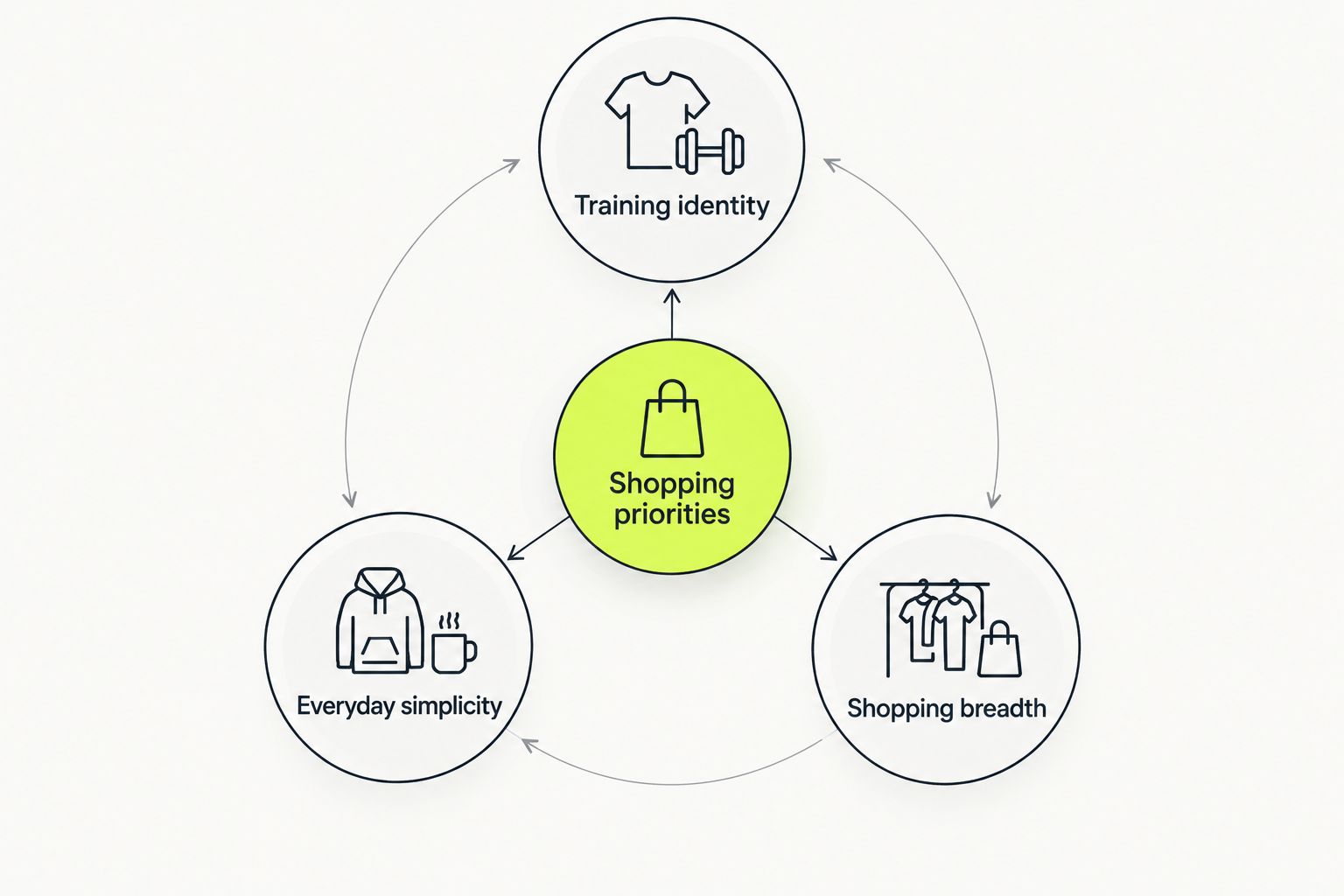
Those advantages solve different problems:
- Training identity: Choose clothing that expresses your interest in fitness beyond a single workout.
- Everyday simplicity: Choose activewear as part of a broader routine purchase.
- Shopping breadth: Combine clothing with unrelated household needs.
Don't confuse a fabric technology name with a measured advantage over another garment. A named material helps you identify what the product description discusses; it doesn't establish comparative breathability, lifespan, or support by itself.
Target wins when you prefer browsing in a physical store
Target operates physical stores as well as online shopping. That gives you a retail setting for comparing garments in person, rather than making your entire decision from a product page. Check the details for the store you intend to visit before making the trip.
In-person browsing is useful if you want to inspect the fabric, compare cuts visually, or decide whether a style matches clothing you already own. It doesn't guarantee that a garment will suit your workout. Movement and comfort still require your attention.
Direct brand shopping suits a different buyer: someone who already wants a dedicated training-and-lifestyle assortment. You can focus your search on the product type and design you want, then read the individual item's sizing and construction information.
Target is the stronger choice for a store-led shopping preference. Direct brand shopping is the stronger approach when the brand's specific style direction is already your priority. Neither shopping channel deserves a performance verdict simply because one involves a store and the other a product page.
Neither name wins on fit without a garment-level check
Fit is a product-and-body question. Your usual letter size doesn't tell you whether a particular waistband, chest opening, or short length will feel right during training. Compare the garment's sizing information with measurements that matter for that item.
The client's catalog includes Hybrid Element 5-inch shorts and a 7-inch version elsewhere in the range. Those named lengths give you a concrete way to narrow your search. They don't settle the waist fit, liner preference, or comfort of either cut.
The TLF Bamboo Stringer Tank description specifies a 1.5-inch racerback stringer width. That's another useful design detail, especially if you have a clear preference for how much coverage you want across the back. It's not a substitute for checking the complete fit.
Use the same checks for either shopping destination:
- Leggings: Bend and squat; assess waistband pressure, movement, and coverage.
- Shorts: Step, hinge, and sit; check whether the cut restricts your movement.
- Sports bras: Match support to your activity, not merely the neckline or closure.
- Tops: Reach overhead; check whether the hem and arm openings stay comfortable.
The fit verdict is a tie: buy the garment that works on your body. Don't transfer a good experience with one pair of shorts to every other product from the same seller.
Neither side earns a blanket durability win
Durability belongs to the garment, its construction, and how you use and care for it. A broad retailer label doesn't prove that an item wears out quickly. A performance-focused brand description doesn't establish a comparative lifespan either.
For your 2026 purchases, inspect the details that affect your actual use. Look at seams, closures, fabric composition, and care instructions. Think about repeated contact with benches, bags, or other surfaces during your routine, rather than treating every workout as the same wear pattern.
The client describes its apparel as using proprietary fabric technology. Specific product descriptions name technologies such as Cotton Luxe DNA(TM), which appears in the TLF Swole Tee description. Use those descriptions to understand the product; don't turn them into an unsupported claim that another garment is less durable.
Treat durability as a tie at the brand level and a decision at the item level. Follow each garment's care label, and judge replacement needs from its condition rather than a fixed calendar.
These training-and-lifestyle tops are examples to consider if that is the direction you choose. Read their individual descriptions before deciding which cut belongs in your wardrobe.


Pricing model: both sell individual garments
Both options let you purchase individual pieces. The difference is the seller: a dedicated apparel brand on one side and a general-merchandise retailer on the other. Neither shopping model alone determines the better value for your wardrobe.
Check current pricing for the exact garments you're considering. Compare equivalent categories, intended uses, and construction details, rather than contrasting a training-focused item with a casual piece that serves a different purpose.
For your 2026 buying decision, prioritize the garment you will actually wear. An appealing purchase becomes a poor choice if its waistband bothers you, its coverage doesn't suit you, or its style stays in the drawer. Buying several pieces before checking the cut magnifies that mistake.
Start with the item that solves your clearest need. Expand the wardrobe only after you know how the fit works for you; don't award either seller a blanket value win based on its business model.
Final verdict: choose your shopping priority
Choose TLF Apparel if you're building a training-led wardrobe
Best for: the training enthusiast who wants Gym-To-Street(R) style. Choose the dedicated brand when you want workout clothing, lifestyle pieces, and graphic tees within a fitness-centered style direction.
Your reason to choose it is focus, not a claim that every item beats every retail alternative. Still check the cut, sizing information, and intended use before committing to a complete outfit.
Choose Target if you're a one-stop everyday shopper
Best for: the shopper adding workout basics to a household shopping trip. Choose Target when general-retail convenience and physical-store browsing are more important than buying into a dedicated training brand.
Your reason to choose it is shopping breadth. Don't assume that convenience resolves fit, support, or garment care; those remain item-level decisions.
| Dimension | Winner |
|---|---|
| Best for a training-led wardrobe | Dedicated fitness brand |
| Training-centered assortment | Dedicated fitness brand |
| Gym-to-everyday brand positioning | Dedicated fitness brand |
| Broader shopping destination | Target |
| Physical-store shopping preference | Target |
| Fit and movement | Tie: judge the garment |
| Durability and care | Tie: judge the garment |
| Pricing model | Tie: individual garment purchases |
FAQ
Is TLF Apparel better than Target for gym clothes?
TLF Apparel is the better match for a training-led Gym-To-Street(R) wardrobe; Target is the better match for general-retail convenience. Fit, support, and durability still require checking the individual garment.
Which is better if I want to shop for workout clothes in a store?
Target is the better match for a physical-store shopping preference. Inspecting a garment in person helps you assess its feel and cut, but you still need to consider how it suits your activity.
Which should I choose for clothes I can wear after the gym?
Choose the dedicated fitness brand if Gym-To-Street(R) styling is your priority. Choose Target if you want straightforward basics to combine with your existing everyday clothing.
Are Target leggings automatically worse for training?
No, a retailer name doesn't establish that leggings are worse for training. Check waistband comfort, coverage during movement, sizing, and the individual product's intended use.
Does a proprietary fabric name prove that a gym shirt performs better?
No, a proprietary fabric name identifies a named material or technology, not a comparative performance result. Read the garment's construction and care details instead of treating the name as a test result.
How should I compare the cost of gym clothes in 2026?
Compare current pricing for garments that serve the same purpose. Then assess fit, construction, care requirements, and whether the item fills a real gap in your wardrobe.
Should I buy a complete workout outfit immediately?
Start with the piece that addresses your clearest need if you're unfamiliar with the fit. Check that garment before extending the purchase across more categories.
One last thing
Choose your least forgiving garment first. If waistband comfort is your main problem, start with leggings; if chest support is the issue, start with a sports bra. Solve the fit problem before choosing the top or layer that completes the look.
That order keeps an attractive outfit from becoming the reason you accept an uncomfortable essential. Your shopping destination matters, but the garment you depend on most should decide the purchase.
Laissez un commentaire